Research laboratory
MahnLab Organoid analysis with 3D holotomography, toward virtual biology
Organoid analysis with 3D holotomography. Long-term: virtual biology — a virtual world.
Research
Can we tell, before treatment, whether a patient’s immune system will attack their cancer? We move from bedside to bench to digital and back, to predict immunotherapy response in lung cancer.
-
 01
Building TOME
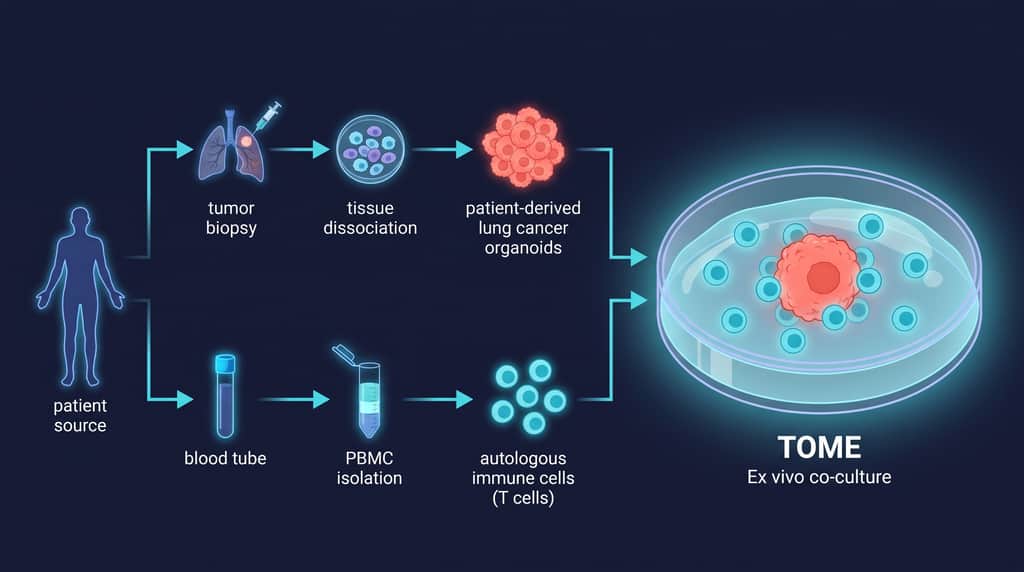
TOME stands for Tumor Organoid MicroEnvironment. From a single lung cancer biopsy or malignant pleural effusion, we dissociate and size-filter tumor tissue and embed it in extracellular matrix to grow patient-derived lung cancer organoids. We confirm with single-cell transcriptomics that the organoids keep the tumor identity of the original tissue.
From the same patient’s blood we isolate PBMCs, sort and expand autologous T cells, and add them back to the organoids. The result is a personalized tumor–immune system in a dish, where we can watch how a patient’s own immune cells respond to their own cancer under immune checkpoint inhibitors.
-
 02
Multimodal data integration
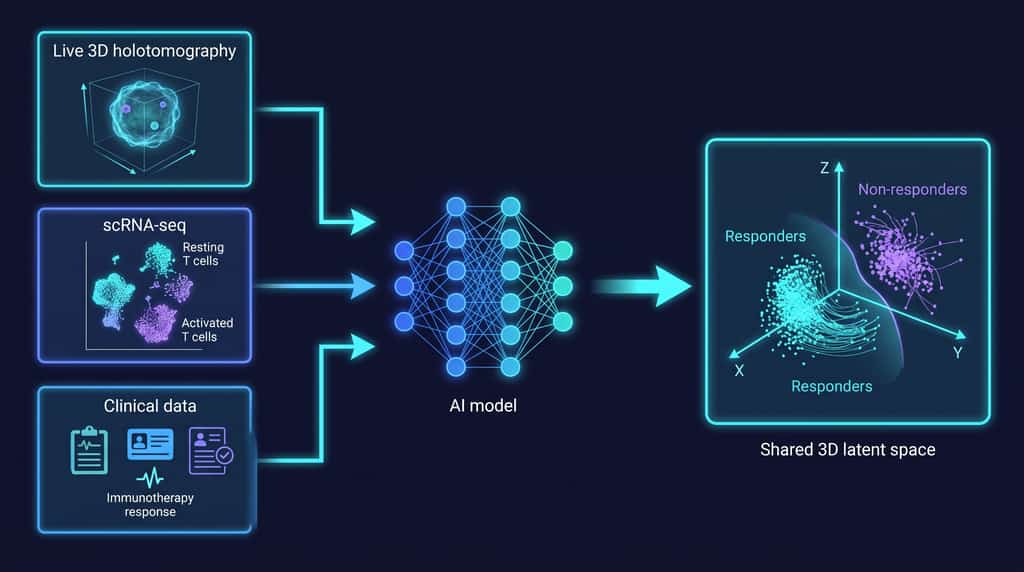
Conventional assays look at fixed, two-dimensional tissue at a single time point. We image living TOME cultures with label-free 3D holotomography, which measures refractive index instead of stains, and follow tumor organoids and infiltrating lymphocytes for hours during checkpoint blockade.
Segmentation and tracking models capture how immune cells approach, contact and attack the tumor. A 3D deep learning model turns these morphodynamics into latent features, which we connect to single-cell RNA sequencing of resting and activated T cells and to each patient’s clinical response, placing image, transcriptome and outcome in one shared space.
-
 03
Virtual organoid
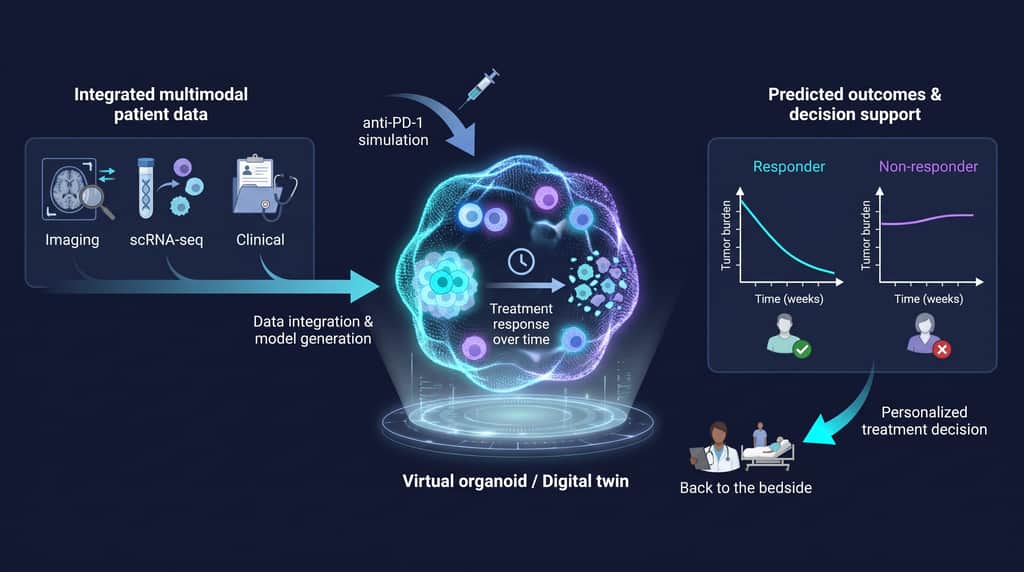
Organoid experiments are powerful but slow and costly, and each patient sample is limited. We use the integrated imaging, transcriptomic and clinical data to train a virtual organoid: a digital twin of each patient’s tumor and immune microenvironment.
In this virtual model we can simulate immunotherapy, compare treatment options and predict whether a patient is likely to respond, then check those predictions against real organoids and clinical outcomes. Our goal is a loop from bedside to bench to digital and back to the bedside, giving clinicians an answer before treatment begins.
Members
Principal Investigator
-
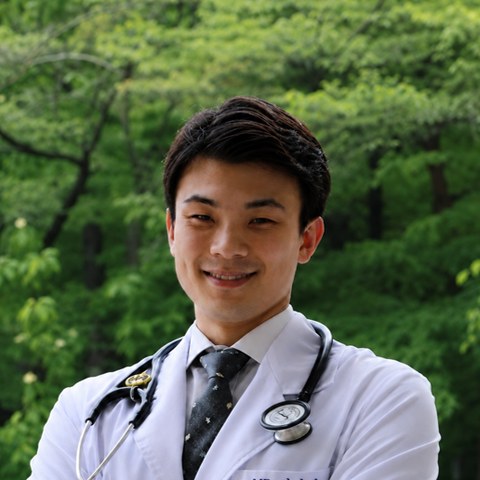
Mahn Jae Lee MD, PhD
Researchers
-
Member 1
-
Member 2
-
Member 3
Administration
-
Member 4
Publications
- 2025 Differential effects of lithium on metabolic dysfunctions in astrocytes derived from bipolar disorder patients Molecular Psychiatry 30(12), 5833–5848 (opens DOI in a new tab)
- 2025 Label-free, high-resolution 3D imaging and machine learning analysis of intestinal organoids via low-coherence holotomography Journal of Visualized Experiments (222), e68529 (opens DOI in a new tab)
- 2024 Long-term three-dimensional high-resolution imaging of live unlabeled small intestinal organoids via low-coherence holotomography Experimental & Molecular Medicine 56(10), 2162–2170 (opens DOI in a new tab)
- 2024 High-resolution assessment of multidimensional cellular mechanics using label-free refractive-index traction force microscopy Communications Biology 7(1), 115 (opens DOI in a new tab)
- 2024 Integrating holotomography and deep learning for rapid detection of NPM1 mutations in AML Scientific Reports 14(1), 23780 (opens DOI in a new tab)
- 2024 Digital cytometry: extraction of forward and side scattering signals from holotomography arXiv preprint arXiv:2408.15522 (opens DOI in a new tab)
- 2023 Enhanced functionalities of immune cells separated by a microfluidic lattice: assessment based on holotomography Biomedical Optics Express 14(12), 6127–6137 (opens DOI in a new tab)
- 2023 Artificial intelligence-enabled quantitative phase imaging methods for life sciences Nature Methods 20(11), 1645–1660 (opens DOI in a new tab)
- 2023 Quantification of structural heterogeneity in H&E stained clear cell renal cell carcinoma using refractive index tomography Biomedical Optics Express 14(3), 1071–1081 (opens DOI in a new tab)
- 2023 Single-shot refractive index slice imaging using spectrally multiplexed optical transfer function reshaping Optics Express 31(9), 13806–13816 (opens DOI in a new tab)
- 2023 Optical trapping with holographically structured light for single-cell studies Biophysics Reviews 4(1), 011302 (opens DOI in a new tab)
- 2023 Label-free histological analysis of retrieved thrombi in acute ischemic stroke using optical diffraction tomography and deep learning Journal of Biophotonics 16(8), e202300067 (opens DOI in a new tab)
- 2023 Virtual biomarkers: predicting immune status using label-free holotomography of individual human monocytes and machine learning analysis bioRxiv preprint 2023.09.12.557503 (opens DOI in a new tab)
- 2022 Quantitative phase and refractive index imaging of 3D objects via optical transfer function reshaping Optics Express 30(8), 13802–13809 (opens DOI in a new tab)
- 2021 Label-free multiplexed microtomography of endogenous subcellular dynamics using generalizable deep learning Nature Cell Biology 23(12), 1329–1337 (opens DOI in a new tab)
- 2021 Effects of osmolality and solutes on the morphology of red blood cells according to three-dimensional refractive index tomography PLoS One 16(12), e0262106 (opens DOI in a new tab)
Announcement
-
We are hiring!
MahnLab is looking for new members at every stage: postdoctoral researchers, graduate students, undergraduate researchers and research staff. All positions are welcome.
If you are curious about organoids, 3D holotomography and virtual biology, we would love to hear from you.
Get in touch
Contact
- mjlee18aug@gmail.com
- Address
- Department of Biochemistry, College of Medicine, Chungnam National University, 266 Munhwa-ro, Jung-gu, Daejeon 35015, Republic of Korea
- Subway
- Daejeon Metro Line 1, Seodaejeon Negeori Station, Exit 1. About 800 m, a 13-minute walk.
- Train
- About 10 minutes by taxi from Daejeon Station (KTX, SRT), or about 5 minutes from Seodaejeon Station (KTX).
- Bus
- About 20 minutes by taxi from Daejeon Bus Terminal, or city bus 615 to the Chungnam National University Hospital stop.